Understanding the Potential Benefits, Risks, and Florida’s Medical Cannabis Program
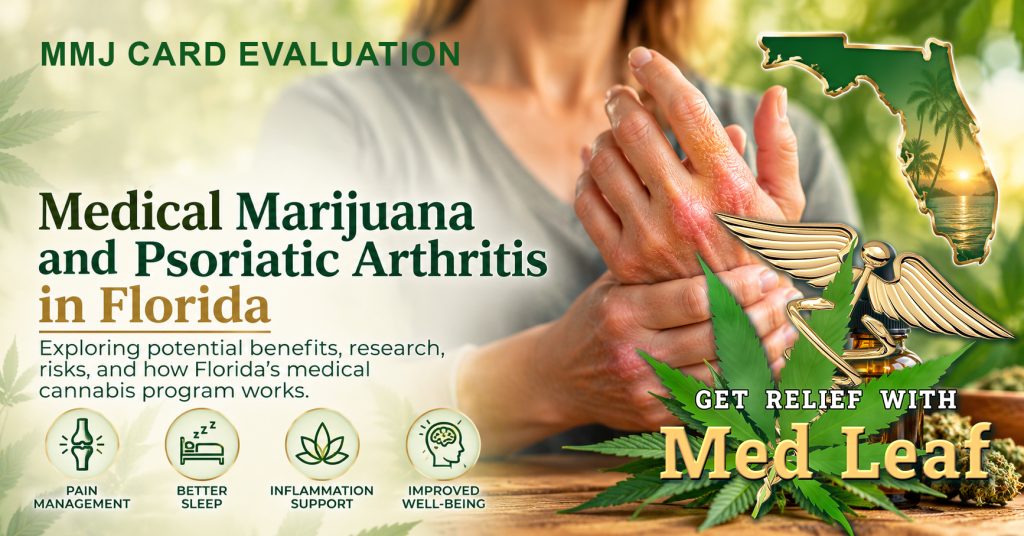
Psoriatic arthritis (PsA) is more than occasional joint discomfort. It is a chronic inflammatory autoimmune condition that can affect the joints, tendons, ligaments, skin, and overall quality of life. For individuals living with psoriatic arthritis, everyday activities such as walking, gardening, working, or even getting a restful night’s sleep can become challenging.
While conventional treatments focus on controlling inflammation and preventing permanent joint damage, some patients are exploring medical marijuana as a complementary option for managing persistent pain, sleep disturbances, and other symptoms.
In Florida, medical marijuana is available to qualifying patients under the state’s regulated medical cannabis program. But can cannabis actually help people living with psoriatic arthritis? What does scientific research tell us, and what should Florida patients understand before considering this treatment?
What Is Psoriatic Arthritis?
Psoriatic arthritis is an immune-mediated inflammatory disease commonly associated with psoriasis, a skin condition characterized by red, scaly patches. However, psoriatic arthritis can also develop in people who have no obvious skin symptoms.
The condition occurs when an overactive immune response triggers inflammation in joints and surrounding tissues. Over time, uncontrolled inflammation can lead to progressive joint damage and disability.
Common symptoms include:
- Joint pain and swelling: Particularly in the fingers, toes, wrists, knees, and ankles.
- Morning stiffness: Stiffness that can last 30 minutes or longer after waking.
- Fatigue: Persistent exhaustion that may interfere with everyday activities.
- Enthesitis: Inflammation where tendons and ligaments attach to bones, commonly affecting the heels and soles of the feet.
- Dactylitis: Swelling of an entire finger or toe, sometimes called a “sausage digit.”
- Nail changes: Pitting, thickening, discoloration, or separation from the nail bed.
- Sleep disturbances: Discomfort and inflammation that make restful sleep difficult.
Psoriatic arthritis can also affect the spine and is associated with other health concerns, including cardiovascular disease, metabolic disorders, and depression.
There is currently no cure for psoriatic arthritis. However, early diagnosis and appropriate treatment can significantly reduce inflammation, protect joints, and improve long-term outcomes.
Medical Marijuana: How Might It Help?
The cannabis plant contains numerous biologically active compounds called cannabinoids. Two of the most widely studied are tetrahydrocannabinol (THC) and cannabidiol (CBD).
THC is the primary intoxicating component of cannabis. It interacts with cannabinoid receptors in the nervous system and may influence pain perception, mood, and sleep.
CBD does not produce the characteristic intoxicating effects of THC. Researchers are investigating its potential effects on inflammatory signaling, pain, and other physiological processes, although evidence for its effectiveness in psoriatic arthritis remains limited.
The human body also has an endocannabinoid system (ECS), a network of receptors, signaling molecules, and enzymes involved in regulating several functions, including pain perception, immune activity, mood, and sleep.
Two important receptors are CB1, found primarily in the nervous system, and CB2, found in many immune cells and peripheral tissues.
Because psoriatic arthritis involves both inflammation and chronic pain, researchers are interested in whether cannabinoids could influence some of these processes.
However, a biological mechanism that appears promising in laboratory studies does not necessarily
Potential Benefits for People With Psoriatic Arthritis
1. Chronic pain management
Persistent joint pain is one of the most challenging aspects of psoriatic arthritis. Even when patients receive appropriate treatment, some continue to experience discomfort.
Research involving certain chronic pain conditions suggests that some THC-containing cannabis products may provide modest short-term pain relief. However, the results vary, and the evidence is not specific enough to establish cannabis as an effective treatment for psoriatic arthritis.
Medical marijuana may alter how pain is perceived without addressing the underlying cause of inflammatory joint damage.
2. Sleep quality
Joint pain, stiffness, and discomfort frequently interrupt sleep. Poor sleep can then worsen fatigue, sensitivity to pain, and emotional well-being.
Some patients report improved sleep after using cannabis products, particularly those containing THC. Yet clinical research has produced mixed findings, and long-term use may contribute to tolerance, sleep disruption, or dependence.
Improved sleep should therefore be considered a possible symptom-related benefit rather than a guaranteed outcome.
3. Inflammation and immune responses
One of the most interesting areas of cannabinoid research involves their interaction with immune cells and inflammatory pathways.
Laboratory and animal studies suggest that certain cannabinoids can influence inflammatory signaling. Nevertheless, there is insufficient clinical evidence that medical marijuana reduces psoriatic arthritis disease activity, prevents joint erosion, or controls the autoimmune process.
This distinction is particularly important because reducing pain does not necessarily mean reducing inflammation.
4. Stress and emotional well-being
Living with a chronic autoimmune disease can create significant emotional strain. Pain, physical limitations, unpredictable flare-ups, and fatigue may affect mood and overall quality of life.
Some individuals report relaxation or temporary stress relief with cannabis. However, THC can also cause anxiety, panic, impaired concentration, or worsening psychiatric symptoms in susceptible individuals.
Cannabis should not be considered a proven treatment for the psychological effects of psoriatic arthritis.
What Does Scientific Research Say?
Although interest in medical cannabis for arthritis has increased, research specifically examining psoriatic arthritis remains limited.
A 2024 systematic review of rheumatic diseases
A systematic review published in Northern Clinics of Istanbul examined 28 studies involving cannabis and various rheumatological conditions, including rheumatoid arthritis, osteoarthritis, fibromyalgia, and psoriatic arthritis.
Researchers identified reports of pain relief and improvements in sleep or mood in some patient groups. However, the evidence varied considerably between conditions, and the findings did not establish cannabis as an effective treatment for psoriatic arthritis specifically.
The authors concluded that additional clinical research is needed.
A 2025 review of autoimmune and rheumatic disorders
A review published in Autoimmunity Reviews in 2025 examined the therapeutic potential of cannabis-based treatments for autoimmune and rheumatic diseases.
The researchers acknowledged possible benefits in symptom management but emphasized that strong scientific evidence remains insufficient for many conditions.
Their findings highlight the need for larger, well-controlled clinical trials to establish effectiveness, appropriate dosing, and long-term safety.
Why conventional treatment remains essential
Medical marijuana is not a substitute for disease-modifying antirheumatic drugs (DMARDs), biologic therapies, or other medications prescribed to control psoriatic arthritis.
These treatments target inflammatory pathways and can help prevent permanent joint damage.
Cannabis has not been demonstrated to provide the same disease-modifying protection.
Can Psoriatic Arthritis Qualify for Medical Marijuana in Florida?
Florida’s medical marijuana program operates under Section 381.986, Florida Statutes.
Psoriatic arthritis is not specifically named among the state’s enumerated qualifying conditions. However, Florida law allows qualified physicians to evaluate certain additional conditions under provisions covering:
- Medical conditions of the same kind or class as, or comparable to, specifically listed qualifying conditions.
- Chronic nonmalignant pain that originates from a qualifying medical condition and persists beyond its usual course.
A diagnosis of psoriatic arthritis or chronic joint pain does not automatically establish eligibility. A Florida-qualified physician must evaluate the patient’s medical history, applicable legal criteria, and potential benefits and risks.
How Florida patients can begin the evaluation process
Step 1: Schedule a medical marijuana evaluation.
Consult a Florida-qualified medical marijuana physician to discuss your diagnosis, symptoms, and medical history.
Step 2: Review your medical records.
Bring available records documenting psoriatic arthritis, previous treatments, persistent pain, and related symptoms.
Step 3: Obtain physician certification, if eligible.
If the physician determines that you meet Florida’s requirements, they can enter the appropriate certification and orders into the Medical Marijuana Use Registry.
Step 4: Apply for your registry identification card.
Complete the required application and receive state approval before purchasing medical marijuana from a licensed Florida Medical Marijuana Treatment Center (MMTC).
Important 2026 Florida update: Effective July 27, 2026, patients must have a current or scheduled physician certification with active registry orders to submit an initial or renewal medical marijuana identification card application.
Florida medical marijuana identification cards generally require annual renewal, while physician certifications require reassessment at least every 210 days.
For official information, visit the Florida Office of Medical Marijuana Use
Medical Marijuana Products and Considerations for Arthritis Patients
Florida’s medical marijuana program permits several routes of administration, subject to physician certification and state requirements.
Product type:
– Oral capsules and tinctures – May provide longer-lasting effects, but onset and duration vary; – Sublingual products – Absorption and onset depend on the formulation;
– Topical preparations – Applied to localized areas; evidence for psoriatic joint pain is limited;
– Edibles – Delayed onset can increase the risk of accidental overconsumption
– Inhaled cannabis – Faster onset, but inhalation carries respiratory and other health risks
No cannabis formulation has been established as the most effective option for psoriatic arthritis.
Patients should also understand that THC-containing products can cause dizziness, impaired coordination, sedation, changes in heart rate, and cognitive impairment. Cannabis may interact with certain medications, including sedatives and drugs metabolized through liver enzymes.
Because psoriatic arthritis is associated with increased cardiovascular risk, patients with heart disease or other significant medical conditions should discuss these risks with their treating physicians.
A Comprehensive Approach to Living With Psoriatic Arthritis
Managing psoriatic arthritis often requires more than one treatment strategy.
Regular rheumatology appointments, appropriate anti-inflammatory or disease-modifying medications, physical activity, maintaining a healthy weight, and good sleep habits all contribute to long-term disease management.
For some eligible Florida patients, medical marijuana may be considered as an additional approach to symptom management after an individualized physician evaluation.
The primary goal should remain controlling the underlying disease while improving comfort, mobility, sleep, and everyday functioning.
Med Leaf: Medical Marijuana Evaluations in Fort Pierce, Florida
Living with chronic pain can affect nearly every part of daily life. Understanding available treatment options is an important step toward making informed healthcare decisions.
At Med Leaf in Fort Pierce, Florida, patients can schedule medical marijuana evaluations to discuss their medical conditions, treatment histories, and potential eligibility under Florida law.
Whether you are seeking an initial evaluation or renewing your existing medical marijuana certification, Med Leaf can help you navigate the evaluation process and understand Florida’s medical cannabis requirements.
Schedule your appointment with Med Leaf today and learn whether medical marijuana may be an appropriate option for you.
Scientific References and Resources
- de Carvalho, J. F., Ribeiro, M. F. L. D. S., & Skare, T. (2024). Cannabis therapy in rheumatological diseases: A systematic review. Northern Clinics of Istanbul, 11(4), 361–366. Read the study
- Exploring therapeutic potential of Cannabis based therapy in autoimmune and rheumatic disorders. (2025). Autoimmunity Reviews. Read the review
- American College of Rheumatology. Psoriatic Arthritis, updated February 2025. Patient information
- European Alliance of Associations for Rheumatology (EULAR). Recommendations for the management of psoriatic arthritis with pharmacological therapies: 2023 update. Read the recommendations
- Florida Legislature. Florida Statutes, Section 381.986 — Medical Use of Marijuana. Read Florida law
Medical Disclaimer
This article is provided by Med Leaf for general educational and informational purposes only. It does not constitute medical advice, diagnosis, or treatment recommendations. Medical marijuana is not a cure for psoriatic arthritis, and its effectiveness and safety for this specific condition have not been established through sufficient high-quality clinical research. Patients should consult their rheumatologist and a Florida-qualified medical marijuana physician before considering cannabis, particularly if they take prescription medications or have other medical conditions. Do not discontinue or modify prescribed treatments without consulting your healthcare provider. Eligibility for Florida’s medical marijuana program is determined by a qualified physician in accordance with applicable state law.

What About Medical Marijuana and Migraine in Florida?

PTSD and Medical Marijuana: What Florida Patients Should Know
Medical Marijuana and Psoriatic Arthritis